
Kate’s K9 Pet Care proudly provides dog walking, cat sitting, small animal pet care, pet taxi services, “Almost Overnight” pet care, and convenient pet supply delivery. To see where we currently operate, please visit our Service Area page.
Looking to add a new pet to your family and thinking about getting a rodent? Good choice! These furry creatures can make for fun, social and cuddly pets. But with so many different rodent species out there (think hamsters, rabbits, guinea pigs, gerbils, mice, rats and more), how do you know which best matches your family? All have different personalities and care guidelines, so it’s important to inform yourself before choosing.
Below, let’s compare three of the most popular pet rodents: gerbil vs hamster vs guinea pig. Which is the right pet for you?
Comparing Gerbil vs Hamster vs Guinea pig
About gerbils
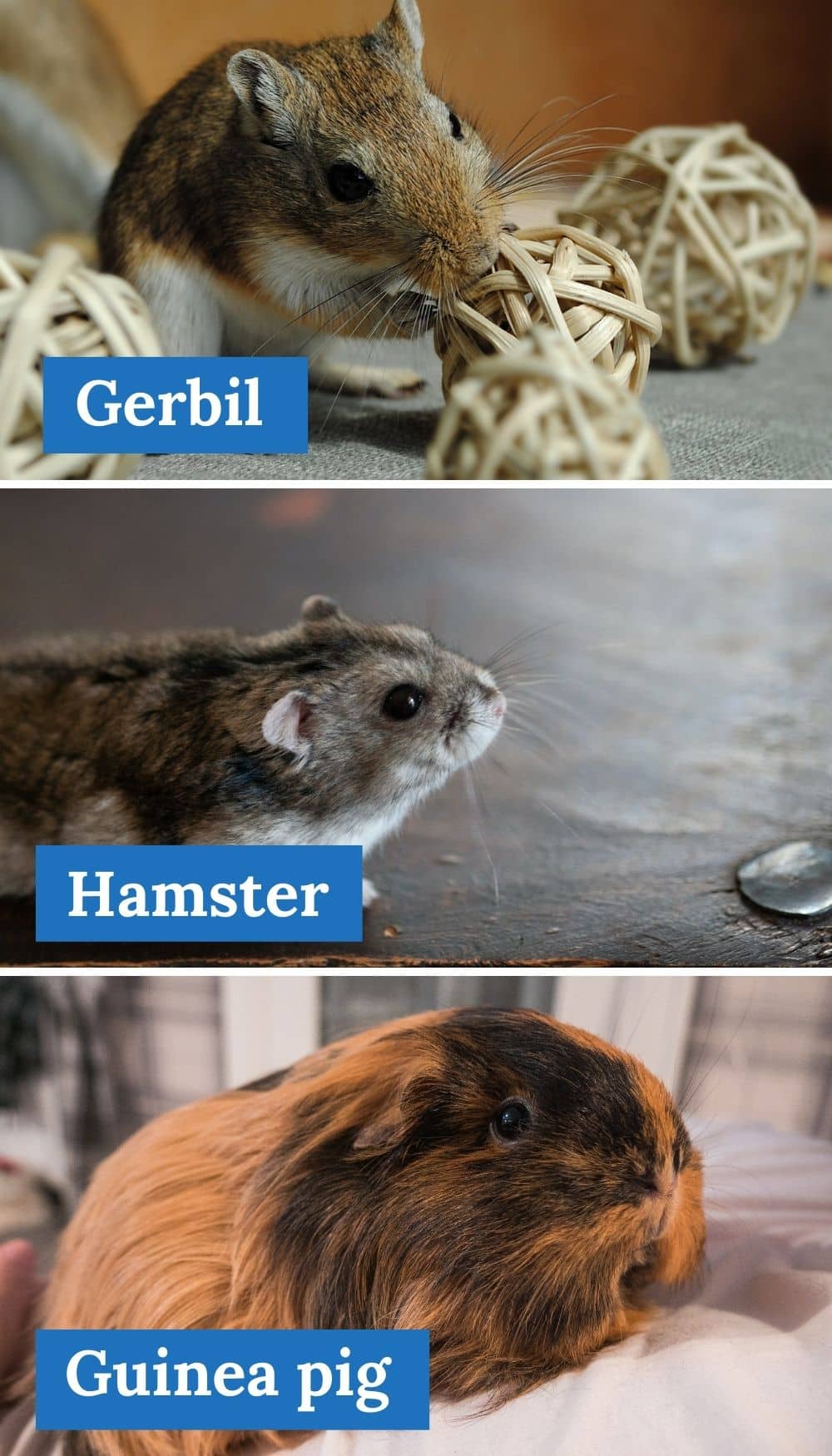
Although it looks almost like a cross between a mouse and a hamster, the gerbil is actually part of a separate genus of rodents called Meriones (the jirds). Scientifically known as Meriones unguiculatus, it hails from the plains and steppes of Mongolia and surrounding regions. You can tell it apart from a hamster by its long tail and longer hind legs.
Although gerbils are not the most popular of the three types of rodents we’re discussing here, they can actually make excellent pets. They’re generally quite social, as well as energetic, playful and rarely bitey. A gerbil will spend the majority of its waking time playing, exploring and running around its cage. It’ll love being able to explore the rest of the house as well, although it might be a good idea to set up an enclosed pen. It’s easy to lose sight of these curious and quick little rodents!
Book services online in just a couple minutes.
Although they’re suitable for children, their small size does make them fragile, so playtime should be supervised.
Here’s what you’ll need if you’d like to keep a gerbil:
- Glass tank (at least 20-gallon capacity, preferably bigger) with a thick layer of bedding like aspen
- Plenty of toys and items to climb
- Exercise wheel (solid, not wire)
- Nest box
- High-quality pelleted food supplemented with fresh vegetables and occasionally fruit
- Multiple sources of fresh water (bottles preferred)
| Size | Up to 5” and up to 130 grams |
| Social? | Keep in same-sex pairs (preferably litter mates) |
| Bites? | Usually not |
| Activity | Crepuscular (dawn and dusk) |
| Lifespan | 3-4 years |
| Enclosure size (minimum) | 20-gallon tank |
About hamsters
Unlike gerbils, the hamsters comprise more than one species of rodent. They belong to the subfamily Cricetinae within the Cricetidae, a large group that also includes such animals as voles and lemmings. The most popular hamster to be kept as a pet is probably the Syrian hamster (Mesocricetus auratus), although dwarf hamsters from the genus Phodopus are also very common.
Hamsters make fun pets, and if you provide yours with a suitable hamster enclosure, you’ll enjoy seeing its natural burrowing behaviors and food storage abilities. Do keep in mind that they’re crepuscular and sometimes even straight-up nocturnal, so they spend most of the day sleeping and don’t like being disturbed. At night, they go wild burrowing, running in their exercise wheel and exploring their cage!
They’re considered relatively low-maintenance pets, but it’s important to keep in mind that they’re not quite as social as something like a gerbil. Socializing your hamster properly is important if you want to be able to handle it. Children should always be supervised while playing with a hamster.
Because they live solitary lives in the wild, hamsters should be kept alone. Otherwise, even their own litter mates can be injured or killed in territorial fights!
If you’d like to keep a hamster, here’s what you’ll need:
- Solid-bottomed cage with wire canopy, at least 31 x 20 x 20″, but preferably bigger
- At least 6-10″ (preferably more) of bedding material like aspen shavings
- Plenty of hamster toys
- Exercise wheel (solid, not wire)
- Hide/nest box with nesting material
- High-quality hamster food blend supplemented with lots of fresh vegetables and some fruit
- Multiple sources of fresh water (bottles preferred)
| Size | Dwarf: up to 4″ and 2 oz. Syrian: up to 8″ and 5,5 oz. |
| Social? | No, keep alone |
| Bites? | Needs careful socialization |
| Activity | Crepuscular (dawn and dusk) |
| Lifespan | Up to 3 years (dwarf) or 4 years (Syrian) |
| Enclosure size (minimum) | 31 x 20 x 20″ |
About guinea pigs
Between gerbil vs hamster vs guinea pig, it’s the guinea pigs that are the odd ones out. Also known as cavies, they belong to the South American genus Cavia. In their natural range, they were actually first domesticated for human consumption, although over time they became popular as pets as well. At a maximum length of around 10″ and weight of up to 2.5 lbs, guinea pigs are much larger than gerbils and hamsters.
If you’ve ever kept guinea pigs before, you’ll know they are social animals. They need to be kept in pairs or groups, and they tend to be quite easy to socialize and even cuddly. Unlike something like a gerbil, they’re pretty mellow, and unlike hamsters, they rarely bite. They can be so happy to see their owners that they burst into spontaneous squeaking when you walk into the room!
Guinea pigs do need a lot more space than either of the aforementioned species, with a big pen or indoor hutch being ideal. It’s best to also let yours roam the house for at least a few hours a day to ensure it gets enough exercise.
If you’d like to keep guinea pigs, here’s what you’ll need:
- 50 x 30″ minimum enclosure, pen or hutch
- Lots of guinea pig toys
- Hide or nest box
- Bedding like aspen or fleece
- Timothy hay as a staple food, plus fortified pellets, vegetables and occasional fruits
- Multiple water sources
| Size | Up to 10″ and 2.5 lbs |
| Social? | Keep in same-sex pairs or groups (females or neutered males) |
| Bites? | Rarely |
| Activity | Crepuscular (dawn and dusk) |
| Lifespan | Up to 8 years |
| Enclosure size (minimum) | 50 x 30″ |
Gerbil vs Hamster vs Guinea pig: Which is the pet for you?
Now that we’ve discovered a little about the characteristics of each of these three popular pet rodents, it should hopefully be easier to figure out which best suits your family between gerbil vs hamster vs guinea pig:
- Choose a gerbil if you want a small, high-energy pet that’s reasonably social.
- Choose a hamster if you want a small pet that can be kept alone, and don’t mind having to slowly get it used to being handled.
- Choose guinea pigs if you have plenty of space available and want a larger, more cuddly pet.
Remember: although they’re considered less work than something like a cat or dog, each of these rodent species still needs daily attention. Guinea pigs are the most high-maintenance of the three, but gerbils also need plenty of attention to keep them happy. Hamsters are generally content to be left alone, but they, too, benefit from being able to run around outside their cage daily in order to keep them fit.
Daily cage inspection is required for gerbils, hamsters and guinea pigs. Any dirty or wet bedding should be replaced, water bottles refreshed and cleaned, and fresh food offered.
Conclusion
Between gerbil vs hamster vs guinea pig, the right rodent for you depends entirely on what you’re looking for, how much space you’ve got available and how much time and money you’re willing to invest. Once you’ve made your choice, be sure to consider adopting rather than buying your gerbil, hamster or cavy at a pet store. There are many in need of a good home!
If you’re worried about leaving your pet alone while you go on holiday, we can help. Our Small Pet Care service is perfect for rodents like the ones discussed here.
Need a hand at home?
Dog walking, cat sitting and in-home pet care across Northern Virginia & Southern Maryland.
More from the blog
Pet Sitting in Alexandria, VA: How to Keep Your Pets Comfortable and Cared for While You’re Away
Leaving your pet at home never gets easier. Maybe it's a long workday downtown, a weekend trip you've been looking forward to, or a two-week vacation that's finally here. Your dog still needs walks, your cat still wants company, your bird still needs fresh water, and...
Dog Walking in Alexandria, VA: How to Keep Your Pup Happy, Healthy, and Active When Life Gets Busy
Dog walking in Alexandria, VA can be a challenge to fit into your busy schedule. Your alarm goes off, you rush through a quick potty break, and you're out the door. Then come the meetings, the school pickups, the Beltway traffic, and the endless to-do list. Meanwhile,...
Dog Walking in Alexandria, VA: How to Keep Your Pup Happy, Healthy, and Active When Life Gets Busy
Your alarm goes off, you rush through a quick potty break, and you're out the door. Then come the meetings, the school pickups, the Beltway traffic, and the endless to-do list. Meanwhile, your pup is home, watching the door and waiting for you. I've seen this story...
Dog Walking for Busy Professionals: How to Give Your Dog the Care They Need While You Work
The alarm goes off, you squeeze in a quick walk, and you head out the door. Then the meetings, the commute, and the deadlines take over. Somewhere in the middle of all that, your dog is at home, waiting for you. I've seen this story play out for more than 15 years....